What Documentation to Request for Critical Infrastructure Materials
Useful records connect the specified requirement to the supplied material. Define the evidence, identifiers and review responsibilities before treating a document package as complete.
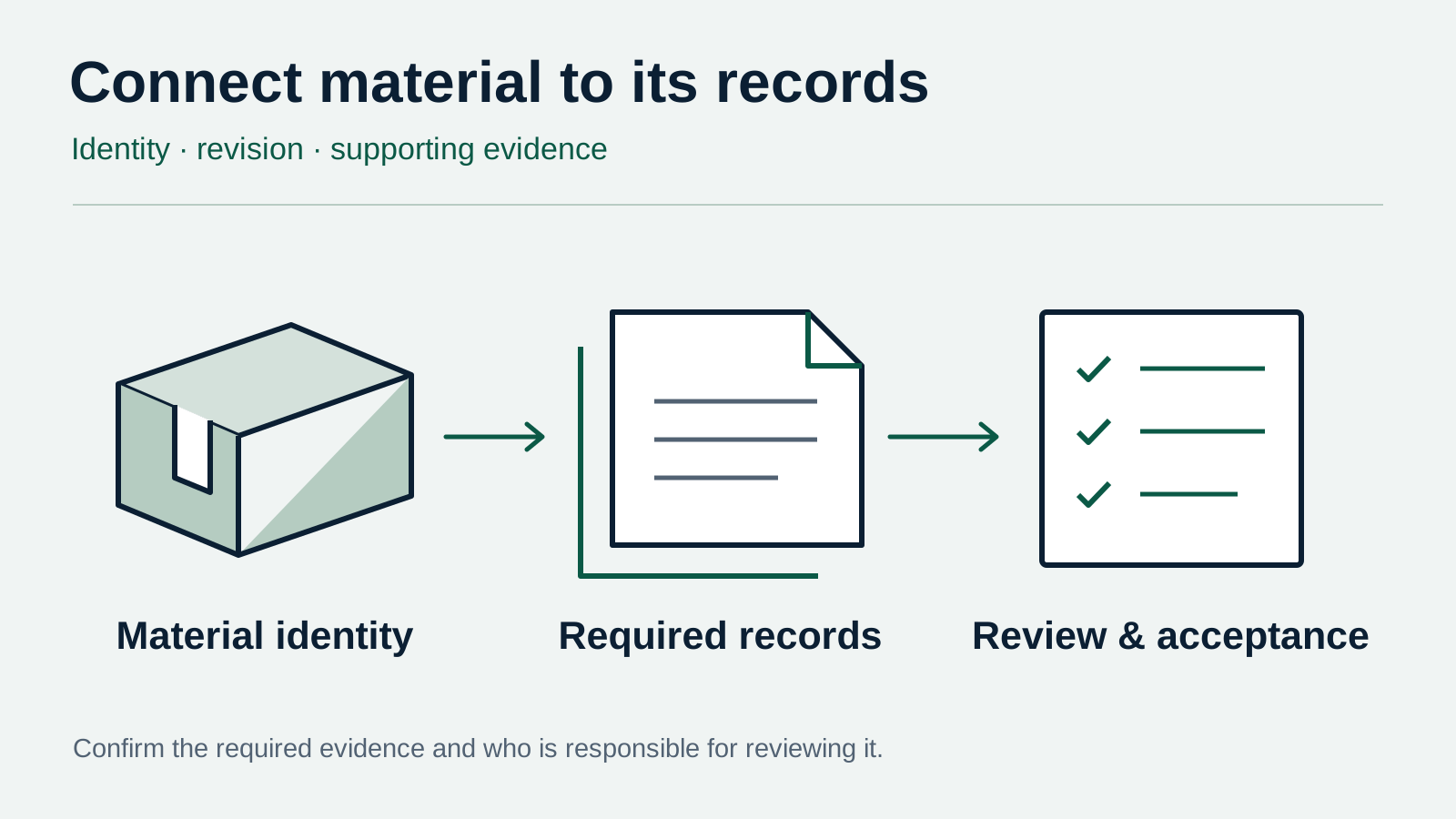
Conceptual documentation chain. Required records and their availability vary by product, supplier and project; the illustration is not a certification or a supplier document.
Original Aurona editorial illustration
Key takeaways
- Define the acceptance question before requesting certificates.
- Distinguish supplier declarations, independent attestations and test results.
- Connect the supplied quantity to the relevant material identifiers and records.
- Treat measurement traceability and material traceability as distinct requirements.
- Confirm document availability, timing and exceptions before commitment.
Start with the decision the record must support
A document package is useful when it answers a defined question: does the supplied material correspond to the specified requirement, and can the relevant evidence be connected to that shipment? Asking for all certificates can produce a large folder without resolving either point. Start with the project specification, the product being purchased and the acceptance decision the reviewer will need to make.
Create a short requirement-to-evidence list before requesting a quotation. For each item, name the required record, the issuer, the identifying information and when it must be available. Ask the supplier to confirm availability and exceptions. The suggestions below are procurement guidance, not a statement that every product must carry the same documents or that a particular record is universally required by law.
A declaration and a test record answer different questions
A supplier declaration states conformity to specified requirements. ISO/IEC 17050-1 addresses this type of declaration, while ISO/CASCO distinguishes first-party, purchaser and independent third-party attestations. A declaration from a supplier therefore should not automatically be described as independent certification. Read who made the statement, what object it covers and the requirements against which conformity is declared.
A material test report, inspection record or laboratory result provides a different kind of evidence. The familiar abbreviations MTR and CoC do not, by themselves, establish a universal document format or a particular level of verification. Define the requested content instead of assuming the abbreviation is sufficient. Where a declaration refers to supporting reports, ask how those reports can be identified and reviewed under the agreed commercial and confidentiality arrangements.
Specify the inspection-document type when the project requires it
BS EN 10204 describes types of inspection documents for metallic products and addresses specific and non-specific inspection, validation and transmission. Its terminology is useful when it is part of the procurement requirement. It should be referenced with the required document type and applicable edition, not reduced to an unexplained request for a certificate. The project team must determine whether and how it applies.
A buyer should not convert a requested document type into a broader promise than the supplier can support. Ask who issues or validates the document, which material it covers and whether any intermediary handling affects the record provided. Resolve a proposed alternative before order placement. If the specified evidence is unavailable, the appropriate response is a recorded exception for review, not a renamed document that appears to satisfy the request.
References: [1]
Connect the record to the supplied material
The practical review depends on identifiers. Determine which heat, batch, lot, coil, piece or serial reference applies to the product and how it is carried through the supply chain. A number printed on a report is helpful only if it can be connected to the material received. Describe the identification expected on packaging, labels, cutting records or other agreed records without assuming every material form uses the same method.
If material is split, cut or processed, ask how its identity remains associated with the outgoing quantity. Keep the original identifier distinguishable from an internal order number. An origin statement, a shipment reference and a test record may all be useful, but they answer different questions. Request origin information explicitly when the project needs it; do not infer country of origin from the address of a sales office or a document’s language.
Match the requested tests to the product specification
The governing material specification helps identify which properties matter. ASTM B187/B187M, for example, addresses copper conductor bar, rod and shapes, including categories of chemical, dimensional, mechanical and electrical requirements. That example illustrates why a request should name the product standard, grade and condition. It does not mean every listed test result must accompany every shipment or that the same specification applies to all conductive materials.
Ask the technical reviewer to identify which results are needed and the acceptance basis for each. Distinguish a product datasheet from results associated with the supplied material. If a dimension or property has a project-specific requirement, show it in the controlled specification or drawing. Avoid purchasing a more elaborate document package simply because it sounds rigorous; procure the evidence needed to support the actual acceptance decision.
References: [5]
Use the word traceability precisely
Material identity and measurement traceability are related to different questions. NIST describes metrological traceability as a property of a measurement result, connected to a reference through a documented calibration chain with uncertainty. It is not a general status conferred on a company, instrument or product by the phrase NIST traceable. A material lot reference does not by itself demonstrate that measurement relationship.
Where the project calls for measurement traceability, request the specific supporting information the reviewer needs. Where it calls for material traceability, define the required chain of identity and records. Keeping these terms separate helps avoid a familiar paperwork problem: a supplier answers the question it understood, while the buyer assumes a different question has been resolved.
References: [4]
Agree timing and responsibility before shipment
Record when each document is required: with the quotation, before release, before shipment or with delivery. These are commercial milestones to agree, not dates to assume. Identify who checks completeness and who evaluates technical conformity. A purchasing coordinator can verify that the requested files arrived, while the assigned technical reviewer determines whether the evidence satisfies the requirement.
Keep changes controlled. If the drawing or material condition changes, ask whether the earlier record still applies. Preserve superseded documents as part of the review trail where the project’s retention rules require it, and label the current accepted revision clearly. Do not edit a supplier’s test result to make it match an order description. Request a corrected or clarified document from the appropriate issuer.
Close the loop at receiving
A useful receiving review compares the order, the physical identification and the document package together. Record discrepancies in the project’s established process and hold unresolved acceptance questions for the responsible person. A complete folder does not prove that every delivered item is correct, and a correctly labelled delivery does not prove that all specified evidence has been supplied.
The aim is an understandable record that survives handoff between procurement, quality, engineering and operations. Clear identifiers, a defined acceptance basis and timely exception handling accomplish more than a long list of unspecified certificates. Request the documents that fit the product and project, confirm what the supplier can provide, and keep the final technical and contractual acceptance responsibilities explicit.
Sources & further reading
- BS EN 10204:2004: Metallic products. Types of inspection documents
BSI · · Accessed
- ISO/IEC 17050-1:2004: Supplier’s declaration of conformity — General requirements
ISO · Accessed
- Attestations of conformity
ISO/CASCO · Accessed
- Metrological Traceability: Frequently Asked Questions and NIST Policy
NIST · Accessed
- ASTM B187/B187M-26: Copper conductor bar, rod and shapes specification
ASTM International · Accessed