Liquid Cooling Is Changing Data Center Infrastructure Procurement
Liquid-cooling purchases cross the boundary between IT equipment and facility systems. A clear interface schedule helps align coolants, CDUs, manifolds, connections and operating responsibilities.
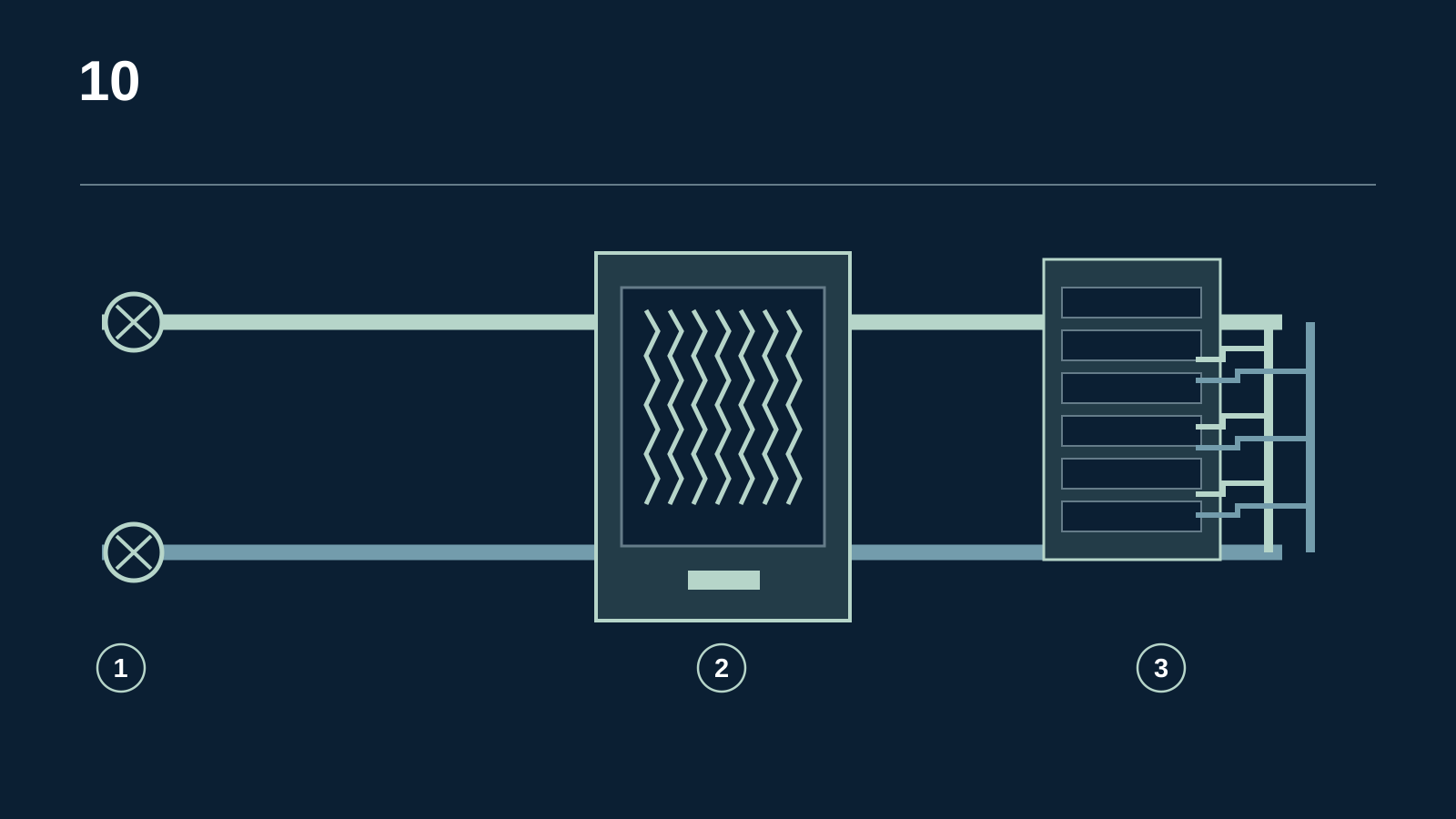
Conceptual cooling interfaces, not a piping and instrumentation diagram. The required fluids, controls, operating limits, leak management and equipment compatibility remain project- and manufacturer-specific.
- 1Facility interface
- 2CDU / exchanger
- 3Rack-side loop
Original Aurona editorial illustration
Key takeaways
- Identify the cooling architecture and the complete heat-rejection path.
- Compare capacities only against a consistent set of approved operating conditions.
- Review wetted-material compatibility for the specified fluid and environment.
- Include connections, leak management, service and documentation in the purchasing scope.
- Assign responsibility for every facility-to-rack interface.
The purchasing challenge is an interface problem
A liquid-cooling package may place a coolant distribution unit, manifolds, hoses, valves and connectors on the same equipment schedule. Those items can still be supplied by different organizations and reviewed by different disciplines. A purchasing description that stops at cooling capacity leaves unanswered questions about how the parts connect, what fluid they encounter and who owns the resulting operating conditions.
Begin with the approved thermal architecture and the equipment boundaries. Identify the IT manufacturer, facility design authority and the supplier responsible for each interface. The objective is not to turn procurement into a cooling-system designer. It is to make the design inputs visible and comparable so that a response does not silently substitute one set of assumptions for another.
Name the cooling approach before comparing products
Liquid cooling covers several approaches. DOE’s guide distinguishes cold plates, immersion and equipment that transfers heat from air to liquid near the rack. It also notes that some arrangements retain an air-cooling requirement. Consequently, a request for liquid cooling is not a complete description of the heat path. State which approach the project has selected and what remains outside the liquid-cooled portion.
Schneider Electric’s architecture paper considers different CDU and heat-rejection combinations. That distinction matters commercially because the facility connections and supporting equipment can differ. Request a simple boundary diagram with each quotation and compare it with the project basis. Keep a proposed alternative separate from the specified arrangement until the responsible designers and equipment manufacturers have evaluated its consequences.
A CDU is part of a defined heat-transfer arrangement
A liquid-to-liquid CDU commonly transfers heat between a technology cooling loop and a facility loop while keeping their fluids separated. Other CDU arrangements transfer heat to air or use a refrigerant-based path. Vertiv’s architecture overview describes these alternatives. A familiar equipment label therefore does not establish which facility services are required or whether the proposed unit matches an existing installation.
Ask the supplier to state the conditions used for the proposed duty, the connections included and the boundaries excluded. Identify the required electrical supply, controls interfaces, access and maintenance provisions in the project package. Do not compare two capacities as equivalent when their stated operating conditions differ. The technical reviewer must reconcile those conditions before procurement uses the offers as a like-for-like comparison.
References: [5]
Specify the fluid and the materials it touches
Coolant compatibility concerns the entire wetted path, including metals, seals, hoses and fittings. Vertiv’s design guidance connects material compatibility to fluid chemistry and operating temperature and pressure. The relevant purchasing question is not simply whether a component carries a water-service label. It is whether the manufacturer confirms suitability for the specific fluid and conditions in the approved system.
Record the fluid identification and approved concentration or chemistry requirements as supplied by the responsible parties. Ask which material and seal information the supplier will provide, and identify any proposed substitution. Avoid deciding compatibility from a generic alloy name or a connector’s appearance. A change in one hose or seal can create a review obligation even when its dimensions and catalogue pressure rating appear to match.
References: [3]
Manifolds and connections need their own schedule
The Open Compute Project’s cooling work spans cold plates, tubing, manifolds, quick disconnects and CDUs. That range illustrates how many interfaces sit between the facility and the heat source. Standardization work is useful context, but the presence of an open specification does not establish that all products using similar language are interchangeable or approved for a particular server platform.
For each interface, identify the mating components, connection orientation, location, required quantity and the drawing that governs them. Ask whether hoses arrive as approved assemblies and what information accompanies them. Distinguish spare connections from the initial connected load. Leave routing, bend limits, restraint and connection procedures to the relevant design and manufacturer documents rather than assuming that a component’s nominal size resolves installation suitability.
References: [4]
Leak management belongs in the operating scope
Detection is only one part of leak management. Vertiv’s guidance discusses leak prevention, detection and intervention together. Procurement should identify the project’s required sensing, alarms, isolation provisions and service responsibilities, then ask suppliers to describe what is included. The exact arrangement and response logic require engineering and operator review; this article does not prescribe valve positions, shutdown sequences or a universal leak threshold.
Discuss service access before equipment is selected. Record which party provides the approved procedures and training, how replacement parts are identified and which maintenance activities require coordination with IT operations. A component that is easy to purchase can still be awkward to service in the final location. That is a reason to bring operations into the review, not a reason to infer a maintenance method from an illustration.
References: [3]
Use an interface register to compare quotations
A concise register can capture the facility connection, CDU connection, distribution connection and rack connection as separate rows. For each row, name the responsible parties, governing drawing, approved operating inputs and unresolved questions. Attach the register to the enquiry so that suppliers can respond against the same boundaries. Keep assumptions and exclusions visible instead of distributing them across unrelated email threads.
Request the documentation appropriate to the package: equipment information, interface drawings, material or fluid compatibility evidence, agreed test records and manufacturer operation and maintenance instructions. Availability depends on the item and supplier, so ask for confirmation rather than promising a universal package. Identify what must be reviewed before release and what will be supplied later with the equipment.
Readiness is more than delivery of the main unit
Consider a hypothetical delivery in which the CDU arrives on time but the rack-side connector selection remains open. The main equipment milestone has been achieved, yet the interface is not ready. Use this kind of dependency review when building the purchasing schedule: identify which decisions enable drawings, manufacturing release, installation and acceptance, and assign an owner to each one.
Liquid cooling rewards careful coordination because the thermal chain crosses organizational boundaries. Buyers can support that coordination by keeping the selected architecture, fluid requirements, interfaces and responsibilities explicit. The final result should be an offer whose technical basis can be reviewed and whose commercial scope can be understood, with suitability and operating approval remaining with the responsible project team and equipment manufacturers.
Sources & further reading
- Best Practices Guide for Energy-Efficient Data Center Design, revised July 2024
U.S. Department of Energy / NREL · Accessed
- Navigating Liquid Cooling Architectures for Data Centers with AI Workloads
Schneider Electric · Accessed
- Designing Data Center Liquid Cooling Systems
Vertiv · Accessed
- Cooling Environments project: scope and specifications
Open Compute Project · Accessed
- Evaluating coolant distribution unit architectures: advantages, considerations, and best use cases
Vertiv · · Accessed