Switchgear Procurement: Questions to Resolve Before the Quote
A switchgear quotation is only as clear as the lineup, ratings, interfaces and review responsibilities behind it. Resolving these questions early makes supplier responses easier to compare without promising a particular delivery outcome.
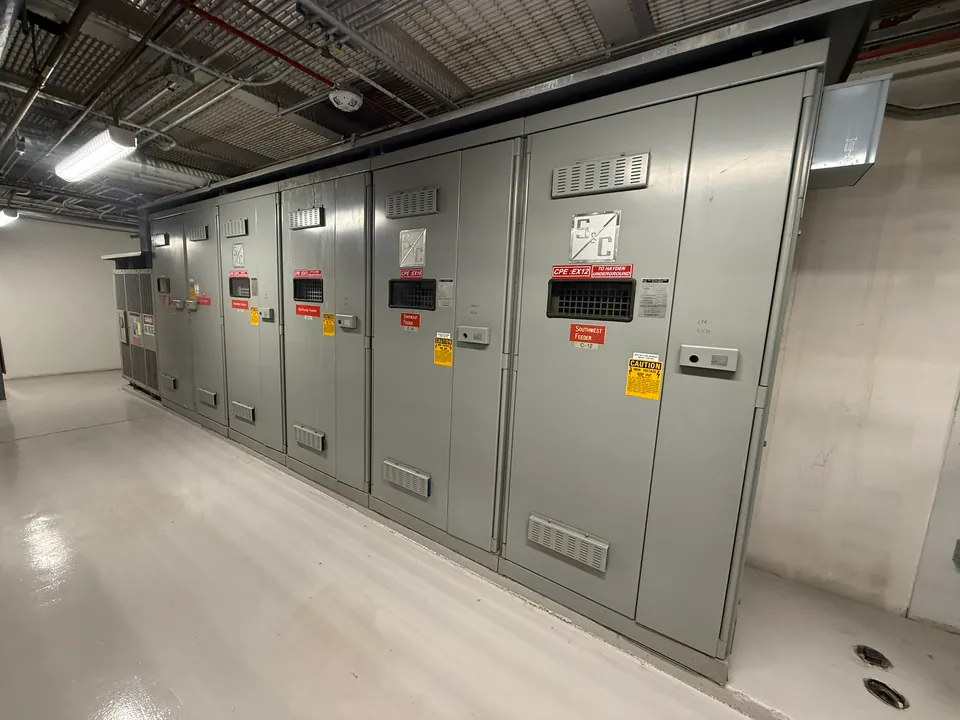
Representative switching equipment in a third-party electrical installation; the photograph does not establish Aurona manufacturer authorization or product availability.
Rsparks3 · CC0 1.0 · Image source
Key takeaways
- Distinguish assembly ratings from protective-device ratings and retain the specified conditions.
- Coordinate electrical diagrams with physical interfaces and the installed-device schedule.
- Document exceptions and approval responsibilities before treating a quotation as ready for release.
Define the assembly and the purchasing boundary
A request for switchgear can refer to a complete lineup, an extension to an existing assembly, a replacement device or a package connected to other equipment. Those requests require different information. Begin with the equipment tag, location, quantity and scope. Say which physical assembly is being purchased and which adjacent systems belong to other parties. Do not assume a supplier will infer that boundary from a project name.
Eaton’s low-voltage overview describes switchgear as an assembly with compartmentalized equipment and distinct operating functions. Its medium-voltage overview distinguishes different construction and access arrangements. These distinctions matter to procurement: an equipment category is not a complete specification. Use the project’s designated equipment type and required standards, with the responsible engineer resolving classification questions. A supplier catalog is a reference for discussion, not permission to substitute a different assembly.
Ask for a rating matrix, not a single current number
Keep system voltage, frequency, continuous-current requirements and fault-duty requirements separate in the RFQ. Identify the ratings that apply to the assembly and those that apply to individual protective devices. Include the specified duration, voltage and applicable basis where relevant. A number followed by kA is not enough to establish that two responses describe the same duty.
Eaton’s medium-voltage fundamentals explicitly distinguishes the interrupting duty of a protective device from the assembly’s withstand duty. Its low-voltage guidance also separates continuous and short-time performance. The procurement response should preserve those distinctions. Ask the supplier to identify its proposed equipment ratings against the project requirement and list exceptions. Determining the available fault current, coordination or protective settings remains the work of qualified professionals, not an inference made while comparing commercial totals.
Coordinate the single-line diagram and the physical arrangement
The single-line diagram explains electrical relationships. It does not, by itself, settle the physical lineup. Provide the arrangement drawing and the information the site team has confirmed about cable entry, adjacent equipment, available space and access. Identify extensions, transitions and interfaces to transformers or busway. Make clear whether existing dimensions are verified or still require a survey.
Schneider Electric’s SureSeT installation guidance directs users to customer order drawings for project-specific foundation arrangements rather than treating typical plans as final. Siemens’ switchgear catalog separately presents section configurations, dimensions and connection arrangements. For procurement, the practical consequence is straightforward: request the proposed arrangement and identify who will approve it. Do not treat a catalog illustration or a preliminary supplier footprint as an approved installation drawing.
Separate installed devices, provisions and future work
Record the required devices and their functions, along with the metering, protection, control power and communications requirements established by the project team. Identify required operating sequences and interlocks through the controlling specification. Ask for clarification when the narrative and device schedule conflict. The RFQ should communicate the approved design intent without inventing operating logic or protection settings.
Consider a hypothetical schedule that says “future feeder” while a drawing shows a breaker symbol. One supplier might include an installed device; another might include space and provisions only. Both could appear responsive to part of the package. Resolve the meaning, update the register and issue the same clarification to each participant. State which future provisions are required now and which future equipment is excluded. This small distinction can materially change the quoted scope without changing the lineup’s headline rating.
Identify the documents and decisions needed after quotation
Ask which drawings, data sheets, agreed test documentation and operating information will accompany the proposed supply. State any project requirement for witness activities, review stages or owner and utility acceptance. Tie each requested item to the equipment scope. “All certificates” is less useful than an identified document, its required content and the stage at which it must be available.
Create a compact approval register: item, reviewer, current status and required decision. It should distinguish acceptance of commercial terms from engineering review of the equipment. A buyer can approve a price while a technical exception remains unresolved; that is not the same as authorizing manufacture. Record which decisions must be complete before a release and ask the supplier to describe any schedule dependence on those decisions.
Compare delivery assumptions and exceptions explicitly
A requested arrival date is a project need. A supplier’s quoted lead time is a statement with its own conditions. Identify the event from which the quoted period runs, whether documentation review is included, and which information remains outstanding. State the receiving destination and responsibility for freight, unloading, storage and any site services. These are commercial questions to resolve in the actual proposal and order.
For each response, maintain an exceptions list alongside the price comparison. Include omitted devices, alternative arrangements, documentation differences and items supplied by others. Keep optional items separate from the base scope. If an alternative is acceptable, obtain the appropriate project approval and revise the comparison accordingly. Do not turn a suggested substitute into an approved equivalent simply by relabeling it in the purchasing spreadsheet.
Use one final package for the release decision
Before moving beyond quotation, reconcile the selected response with the latest agreed package. Confirm that changes made during clarification have reached the drawings, schedules and commercial scope. Identify the party responsible for each remaining interface. A documented open question is easier to manage than a hidden assumption discovered when equipment reaches the site.
The goal is a reviewable decision, not a claim that every project risk has disappeared. Clear equipment identity, separate rating requirements, coordinated interfaces and named reviewers give suppliers a usable basis for responding. They also help the buyer explain why a particular offer was selected. None of these steps guarantees manufacturing capacity or delivery; those commitments must come from the actual supplier under the agreed project conditions.
Sources & further reading
- Low-voltage switchgear fundamentals
Eaton · Accessed
- Switchgear: fundamentals of medium-voltage switchgear
Eaton · Accessed
- Installation — SureSeT MV Indoor Switchgear User Guide, NNZ9886800
Schneider Electric · Accessed
- SPEEDFAX Product Catalog — Section 14, Switchgear
Siemens · Accessed